
PROGRAM
Azul Barrientos, arr. José Luis Irizarry | Gracias Vida
Azul Barrientos, arr. José Luis Irizarry | Canción al Viento
Azul Barrientos | Estrellita de Agua
Franz Schubert | Piano Trio in B-flat Major | II. Andante un poco mosso
Azul Barrientos, arr. Julian Herreros and José Luis Irizarry | Coatlicue
Johann Sebastian Bach, arr. Anne Dudley | Chaconne in D Minor
Azul Barrientos, arr. José Luis Irizarry | Amanecer
Claude Debussy, arr. Troy Peters | Clair de Lune
Lyrics
GRACIAS VIDA
I Come on a Moonlit Night
To sit with grandmother
To talk without words
And to listen to the stars
I bring doubts, I bring sorrows
And thoughts that entangle
She calmly looks at me
And guides me toward old memories
I’m learning to live
To observe and to appreciate
Without ties, without fear
Without deception or banners
Without betraying myself
I surrender and move forward
Our gazes descend
We cleanse ourselves of traps
Suffering dissolves
Flow, flow, heal the soul
Grandmother soothes us
In sacred harmony
With her voice of earth and water
Song of the serpent and life
And when I can let go
With gratitude in my soul
My heart flies free
There are no barriers, no bonds
And with every breath I feel
That love that is the greatest thing in life
Thank you, breeze that caresses
Thank you, water that refreshes
Every tree and little plant
And the life they grant
I feel the pulse of the earth
And the love
That overflows in me
Thank you, beautiful grandmother
For reuniting me with my mother
Thank you, Wind, Fire, Water
Thank you, Earth, Life, and Death
Thank you, Sun, thank you, Moon
Thank you, dancing stars
Thank you, past and present
Thank you, life, for calling me
Thank you, parents, for raising me
Thank you, great spirit, for filling me
Thank you, ancestors, for guiding me
Thank you, life, for loving me
CANTO AL VIENTO
This song is for the wind,
That lifts up leaves and hesitation
He gathers evenly
All that wanders loose.
Faithful companion to the fire,
Your arrival brings commotion and play;
Dances light up
Under a single star.
Wind, rising and falling,
The stillness cracks.
Wind, your strength and your height
Belong to no one but that ancient hill.
Coming down the mountain
Bathed in sunlight,
You return as calm
Jasmine-scented,
The branches singing.
In the darkest hollows,
Your living breath restores the soul;
You reach deep within
And lift it into song.
Wind, rising and falling,
Free and weightless.
Wind you renew all time
And lift your flight.
COATLICUE
Lady, witness of this time,
You live wherever you choose to be.
You walk along the edge of silence,
A hummingbird feather brings you light.
Coatlicue, Coatlicue,
Mother of the light and the dark.
Coatlicue, Coatlicue,
Mother of the eternal and the fleeting.
Your children wake in the night,
Little stars, small tears of hope.
Day by day they face a new struggle,
Bringing offerings and also revolution.
Coatlicue, Coatlicue,
Mother of the light and the dark.
Coatlicue, Coatlicue,
Mother of the eternal and the fleeting.
From your womb the waters rise,
The eternal fire dances on your skin.
Blooming, the wind takes flight
Song of the dawn.
Coatlicue in every moment,
Coatlicue in every place,
Root of knowledge
Look at me, for we are here.
Coatlicue, Coatlicue
Mother of the light and the dark.
Coatlicue, Coatlicue,
Mother of the eternal and the fleeting.
AMANECER
I carry in my blood the trace
Of conquest’s darkest nights,
Wars that silenced ancient voices
And stripped away my mother tongue.
But I also carry stars,
The dreams of my grandmothers,
Their seeds planted deep in the earth,
My navel as the witness.
With our hearts in our hands, we rise toward a brand new day.
Together and unafraid, we walk toward a brand new day.
One heartbeat, one life, calling forth a brand new day.
The earth, our living compass, guides us to a brand new day.
May hatred turn to ash, opening a brand new day.
Wind, carry this prayer, into a brand new day.
For when the river goes quiet,
hope will fade away.
But as long as you sing, beloved river,
From your voice, mine is born
Calling in a brand new day.
program notes
During the last two years of Franz Schubert’s life, his most profound, complex, and fully committed works poured out of him. From his last three piano sonatas to his timeless song cycle Winterreise to his sublime String Quintet in C Major, it seems as though he was aware of his limited time and was urgently producing masterpieces. His Piano Trio in B-flat Major is such a masterpiece, and the second movement (Andante un poco mosso) featured on this program is the emotional heart of the four-movement work. Patient, reflective, serene, the movement is a tender song that drifts between uncertainty and acceptance. Minor section sections cause ripples of disturbance and anxiety that ultimately give way to a higher power and broader perspective. When the opening melody returns after a nostalgic middle section, it feels transfigured, as though the memory of sadness has deepened its warmth.
The Chaconne from J.S. Bach’s Partita No. 2 in D minor is one of the most famous works in classical music literature, and it deserves every bit of its acclaim and longevity. Structurally, a chaconne features a repeated bass pattern that generates a cyclic harmonic progression, over which a melody and other material develop. One of the many incredible things about this particular chaconne is that it was intended for a single instrument, the violin. That means the repeating bass, the chords that support that bass, and melodic material on top of that all need to be considered and sensitively performed by that single violinist. As Johannes Brahms wrote to Clara Schumann about the work, “On one stave, for a small instrument, the man writes a whole world of deepest thoughts and most powerful feelings.” The chaconne has a dramatic shift in key from minor to major midway through the work, which changes the emotional environment from one of incredible drama and tension toward one of acceptance and bittersweetness. This program’s arrangement of the chaconne of the piano quartet stems from one for piano trio written by the critically acclaimed British composer Anne Dudley, masterful in its ability to capture the intense struggle and drama of the Chaconne, heightened climatic moments with highly appropriate changes in dynamics, texture, and sweep. It is not at all easy to produce an arrangement of such a staple from the Baroque Era that supports the emotional drama of such a work without cheapening it – Dudley’s arrangement does incredible justice to Bach’s vision. Our own adjustment in adding viola serve to deepen the texture, offer more dialogue between voices, and further heighten the works’ more dramatic moments.
Clair de Lune (“Moonlight”) by Claude Debussy is as famous a work as it gets; its radiant, suspended harmonies and tender lyricism have captured our hearts for over a century. Yet beneath its romantic familiarity lie metaphors for the ephemerality of life, and the light and shadow that govern our human condition. Paul Verlaine’s celebrated poem of the same name inspired Debussy to create this vulnerable soundscape:
Votre âme est un paysage choisi
Que vont charmant masques et bergamasques,
Jouant du luth et dansant, et quasi
Tristes sous leurs déguisements fantasques.
Tout en chantant sur le mode mineur
L’amour vainqueur et la vie opportune,
Ils n’ont pas l’air de croire à leur bonheur
Et leur chanson se mêle au clair de lune,
Au calme clair de lune triste et beau,
Qui fait rêver les oiseaux dans les arbres
Et sangloter d’extase les jets d’eau,
Les grands jets d’eau sveltes parmi les marbres.
Translation:
Your soul is a chosen landscape
where charming masqueraders and dancers move,
playing the lute and dancing — and almost
sad beneath their fantastic disguises.
While singing in a minor key
of victorious love and the easy life,
they do not seem to believe in their happiness,
and their song mingles with the moonlight,
with the still moonlight, sad and beautiful,
which makes the birds dream in the trees,
and the fountains sob with ecstasy —
tall, slender fountains among marble statues.
*Composer, conductor, and music director of YOSA Troy Peters has arranged this work especially for Agarita and Azul Barrientos.
featuring
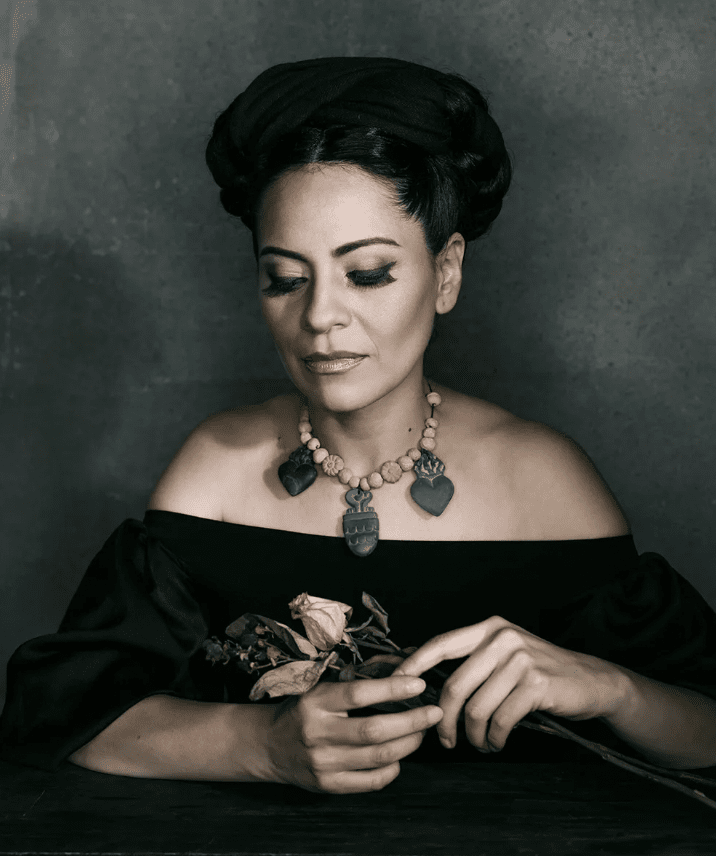
Azul Barrientos is a musician dedicated to observing and conserving the cultural influences and interconnections between Latin America, Africa, Europe, and Mexico.
Born in Mexico City, Azul moved to San Antonio, Texas as a young woman, where she developed a reputation for building bridges between Mexicana and Chicana cultures. Her career has focused on preserving traditional songs from Latin America and exploring their diverse musical histories.
As the daughter of two musicians in Mexico City, Azul was introduced to Latin America's traditional and folkloric songs at an early age. This legacy drives her passion for reviving lost cultural traditions and sharing each song's unique history
Azul rejoices in her Latina roots, giving new life to the rhythms and stories of previous generations.
SAY SÍ
Serving San Antonio’s youth, SAY Sí is a year round, long-term, non-profit multidisciplinary arts program that provides students opportunities to develop artistic and social skills in preparation for higher educational advancement and professional careers. Agarita and Azul worked with students of Amalia Ortiz, Stevan Živadinović, and Alex Ramirez producing poetry and art in collaboration with tonights selections.