
PROGRAM
Suliman Tekalli, violin
Caroline Shaw - Other Song
W. A. Mozart - String Quartet No. 19 , "Dissonance", KV 465 | Adagio - Allegro
Caroline Shaw - By & By | Will There Be Any Stars in My Crown | I'll Fly Away
Caroline Shaw - Entr'acte
Caroline Shaw - Concerto for Harpsichord and Strings | Movement 1
Caroline Shaw - And So
Caroline Shaw - Concerto for Harpsichord and Strings | Movement 3
Caroline Shaw - What Are You After?
D. Shostakovich - Prelude in A Minor, Book I
J.S. Bach / F. Busoni - Wachet auf
D. Shostakovich - Fugue in A Major
Caroline Shaw - How Do I Find You?
Toon Hermans - Lente me
program notes
Caroline Shaw is a Grammy- and Pulitzer Prize–winning composer, violinist, and vocalist known for a distinctive musical voice that bridges past and present. She draws deeply from historical forms, including Renaissance polyphony, Baroque dance, and classical structures, reimagining them through her own contemporary lens. Never superfluous, her music often grows organically from a simple seed, blooming from experimental sounds and timbres that accumulate toward a cathartic reveal. Her music feels both timeless and newly discovered, honoring tradition while reshaping it into something vividly personal and modern. Agarita is honored to have the chance to work intimately with one of the most important composer-performers of our time.
The program begins with Other Song, an invitation to seek light in dark places, discover beauty in old materials, and journey together through the unknown. After five repeated chords, an underlying mantra in this song, Caroline sings:
find where you go
behind the glare is what i know
the melody climbs higher
the song is in the fold
the harmony is cold
what’s old is new is ever ever told
i go where you are
i know there is no
assigned melody
the song is in the fold
the harmony is cold
what’s old is new [is old] [is new] is ever ever told
find the line
i go where you go
Wolfgang Amadeus Mozart’s String Quartet No. 19, nicknamed the “Dissonance” quartet, opens in an extremely unusual way. The Adagio introduction, which earned it its nickname, unsettles the listener from the very first measures, with crunchy intervals and minor modulations that provide no relief over the cello’s insistent, repeated bass notes. Chromatic lines drift, suspensions linger, and the sense of C major (the key of the piece) feels strangely obscured. For early audiences, these harmonies were shocking; today, they sound like Mozart briefly stepping beyond the Classical world into something more searching and ambiguous. As relates to this concert, we hear the potential for the music of Mozart to feel modern in its harmonic search. But this is, after all, a Mozart who is aware of his 18th century audience and their desires: the arrival of a bright Allegro brings clarity and light to the dark crisis of the opening. As the final quartet in the set dedicated to his mentor Haydn, it both honors Classical balance and quietly stretches its limits. A graceful, balanced sonata form unfolds, full of wit and elegance – yet the memory of the introduction lingers, with subtle harmonic turns that hint at the earlier unease.
For this performance, the first movement of Mozart’s quartet is intentionally cut short, making way for Shaw’s Haydn-inspired Entr’acte. About her quartet, Shaw writes:
Entr’acte was written in 2011 after hearing the Brentano Quartet play Haydn’s Op. 77 No. 2 — with their spare and soulful shift to the D-flat major trio in the minuet. It is structured like a minuet and trio, riffing on that classical form but taking it a little further. I love the way some music (like the minuets of Op. 77) suddenly takes you to the other side of Alice’s looking glass, in a kind of absurd, subtle, technicolor transition.
In her set of songs By and By, Shaw turns to the American hymn tradition, and reimagines it from within. These familiar songs, carried across generations, are treated as living memories, their melodies gently reshaped. Originally a popular old Baptist hymn, Will There Be Any Stars in My Crown? was written in 1897 by Eliza E. Hewitt and set to a melody by John R. Sweney. Shaw’s own intimate arrangement unfolds as a quiet meditation with a questioning spirit.
I am thinking today of that beautiful land
I shall reach when the sun goeth down;
When through wonderful grace by my Savior I stand,
Will there be any stars in my crown?
Will there be any stars, any stars in my crown
When at evening the sun goeth down?
When I wake with the blest in the mansions of rest
Will there be any stars in my crown?
In the strength of the Lord let me labor and pray,
Let me watch as a winner of souls,
That bright stars may be mine in the glorious day,
When His praise like the sea billow rolls.
O what joy it will be when His face I behold,
Living gems at his feet to lay down!
It would sweeten my bliss in the city of gold,
Should there be any stars in my crown.
High King of heaven, my victory won,
May I reach heaven's joys, O bright heaven's Sun!
Heart of my own heart, whatever befall,
Still be my Vision, O Ruler of all.
I’ll Fly Away (Originally by Albert E. Brumley from 1929) offers a contrasting sense of lightness, but avoids a purely jubilant tone. Shaw leans into the song’s simplicity and openness, allowing it to feel less like a proclamation and more like a soft, airborne release.
Some glad morning when this life is o'er,
I'll fly away;
To a home on God's celestial shore,
I'll fly away.
(Refrain)
I'll fly away, Oh Glory
I'll fly away;
When I die, Hallelujah, by and by,
I'll fly away.
When the shadows of this life have gone,
I'll fly away;
Like a bird from these prison walls I’ll fly,
I'll fly away.
O how glad and happy when we meet,
I’ll fly away;
No more cold iron shackles on my feet,
I’ll fly away.
Just a few more weary days and then,
I'll fly away;
To a land where joy shall never end,
I'll fly away.
Shaw’s Harpsichord Concerto places one of music history’s most iconic instruments into a contemporary sound world. Rather than treating the harpsichord as a historical artifact, Shaw uses its unique timbre the way experimental pop artists did in the 60’s and 70’s – as a coloristic tool, and a way to signify a surreal and displaced experience. What begins as a presentation of straightforward triads (3-note chords), quickly becomes a frenetic journey through a mystical forest as the music picks up speed and the strings encourage a wild harmonic direction. Mystery fills the first movement as the music struggles to find a grounded key, and after releasing into a finale of disjointed pizzicatos (plucking from the strings), the movement ends unresolved.
For this program, the Harpsichord Concerto will be interrupted by Shaw’s song And So, which explores the fragile relationship between language, sound, and meaning. The text plays with the poetic devices of rhyme, meter, and repetition while reflectively asking whether words hold meaning on their own, or only through connection. Shaw draws on two literary touchstones: Romeo and Juliet, with its question of whether a name shapes essence, and Gertrude Stein’s “a rose is a rose is a rose,” where repetition itself becomes meaning. The song on this program serves as a virtual “second movement” of the Harpsichord Concerto, an introspective aria between instrumental action.
Would a song by any other name
Sound as sweet and true?
Would all the reds be just the same
Or violets as blue?
If you were gone
Would words still flow
And would they rhyme with you?
If you were gone
Would I still know
How to love, and how to grow
And how the vowel threads through?
And so, you say, the saying goes
A rose is a rose is a rose is a rose
Is a rose is a rose is a tired rhyme
But in the verse there's always time
Would scansion cease to mark the beats if I went away?
Would a syllable interrupt the feet of tetrametric iambs when I am gone?
Listen, and I will sing a tune of love and life, and of the ocean's prose
And the poetry of a red, red rose that's nearly sprung in June
And so, you say, the saying goes
A rose is a rose is a rose is a rose
Is a rose is a rose is how I'm
Keeping track of time
The third movement of her Harpsichord Concerto, which we will return to immediately after “And So,” launches immediately into a riff that one might hear from an electric guitar. When that manic, determined energy dissipates and finds new direction, the strings lead a wave of brooding transitions that returns us briefly to one of the melodies we heard in the first movement. Drifting into new, circular passages of modulating harmonies guided by the harpsichord’s incessant 16th notes, the music eventually lands on a D major chord, as if our character has exhausted herself completely from all her adventuring and passed out on the grass.
In her work What are you after? for solo viola and loop pedal, Shaw builds a piece from short, repeated phrases and shifting textures to create a sense of searching without resolution. At times the voices seem to align; at others, they pull apart, as if circling the same idea from different angles. Through use of the loop pedal, Shaw creates a three-dimensional texture with a live dialogue with herself, resulting in an intimate play of memory.
Many composers, particularly in the 20th century, have been intrigued by Bach’s exercise of composing 24 Preludes and Fugues, one for each key. In the case of Dmitri Shostakovich, a particular pianist sparked his impetus to take on the task. In 1950, marking the bicentennial of Bach’s death, he sat on a jury panel for the International Johann Sebastian Bach Competition. Part of the requirement for the competitors was to prepare a couple Preludes and Fugues from the two volumes. One contest – 26-year-old Tatiana Nikolayeva – came with all 48 prepared, so she simply needed to ask them, “which would you like to hear?” Impressed by Nikolayeva and with newfound inspiration, Shostakovich completed his own set within 6 months and dedicated the work to Nikolayeva. Her 1962 recording of the complete set, supervised by Shostakovich himself, is definitive. Like Bach’s, these works are a compendium of moods and styles, each Prelude and Fugue a small, individual poem that expresses its unique key. The Prelude in A Minor is fleeting. A rapid set of arpeggiated figures race down the keyboard, expressing harmonies familiar and surprising, to produce an activity that is too difficult for the listener to firmly grasp. It is an exercise in velocity and texture, and is perhaps best listened to in a passive way, allowing the notes to become larger gestures that provide direction and shape. His Fugue in A Major, on the other hand, is patient and kind, and a very different way to explore a simple arpeggio, or broken chord. The subject or melody of this fugue is simply that, an arpeggio in A major, explored top to bottom and rotated to create beautiful shapes. As in Shaw’s music, Shostakovich here explores what different colors and shades emerge when a single melodic object is turned and pivoted. Between these two works by Shostakovich lies J.S. Bach’s Zion hört from his Cantata Wachet Auf, ruft uns die Stimme, BWV 140, reimagined by the Italian composer and pianist Ferrucio Busoni. Busoni, born in 1866, imbues the movement with his own reflective and romantic sensibilities, so the music feels like a monument, or a powerful memory. Honoring the counterpoint of Bach’s original work, he is careful to bring out each melody and countermelody in striking relief.
Shaw’s song How Do I Find You? builds a quiet, intimate meditation around the desire to reach someone across distance or absence. The text is spare, but charged with longing. By gently repeating phrases, a rising set of chords in the piano, and subtle harmonic shifts, the music is perpetually suspended, and the music circles rather than resolves. The vocal writing is clear, insistent, and almost stuck – against the piano’s undulating motions, the listener is left unmoored.
Our program ends with fragility and openness. Shaw was inspired to arrange the song Lente Me, originally by the legendary Dutch cabaret singer Toons Herman. The result is a gentle, open-hearted love letter.
featuring
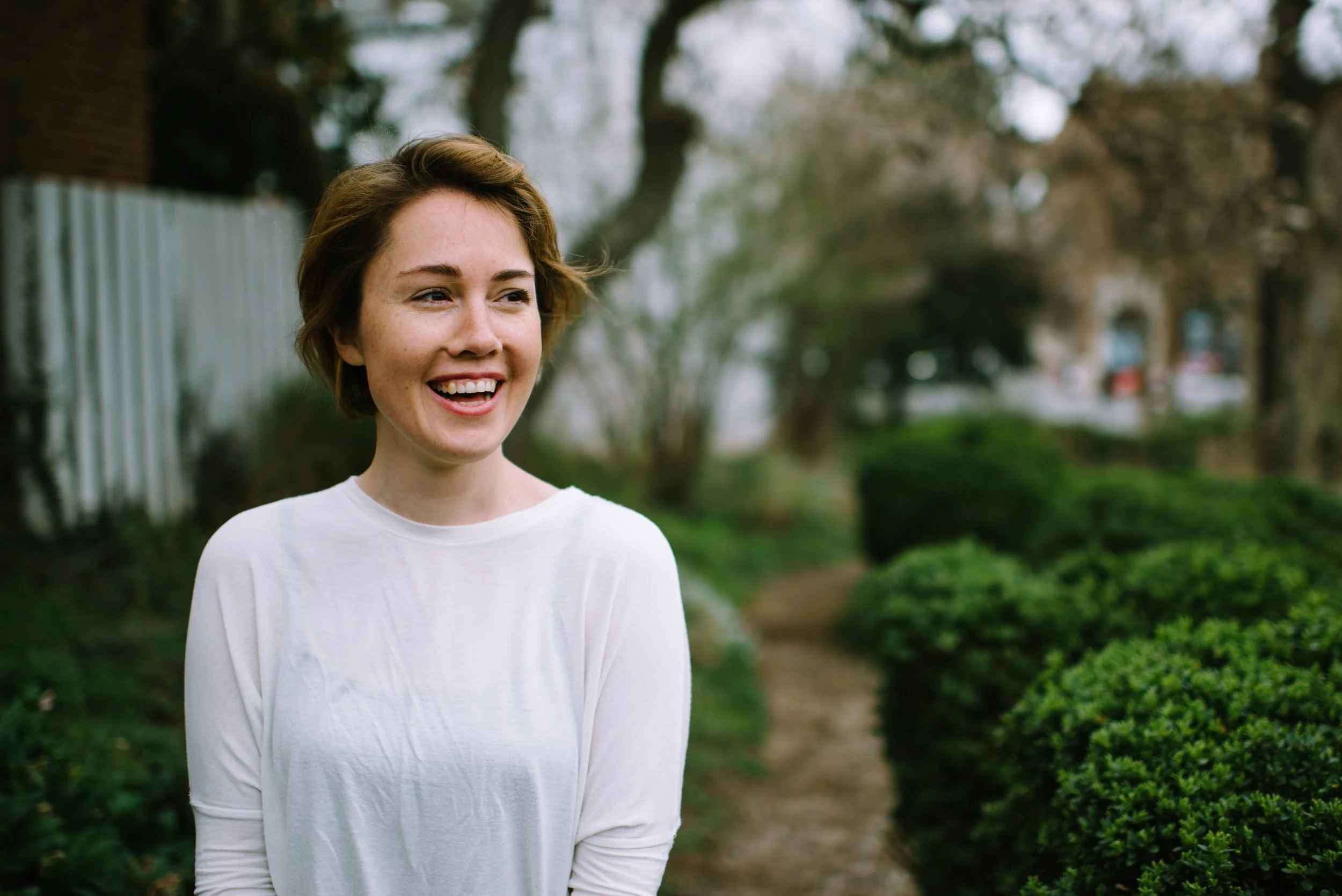
Caroline Shaw is a musician who moves among roles, genres, and mediums, trying to imagine a world of sound that has never been heard before but has always existed. She works often in collaboration with others, as producer, composer, violinist, and vocalist. Caroline is the recipient of the 2013 Pulitzer Prize in Music, several Grammy awards, an honorary doctorate from Yale, and a Thomas J. Watson Fellowship. This year’s projects include the score to “Fleishman is in Trouble” (FX/Hulu), vocal work with Rosalía (MOTOMAMI), the score to Josephine Decker’s “The Sky Is Everywhere” (A24/Apple), music for the National Theatre’s production of “The Crucible” (dir. Lyndsey Turner), Justin Peck’s “Partita” with NY City Ballet, a new stage work “LIFE” (Gandini Juggling/Merce Cunningham Trust), the premiere of “Microfictions Vol. 3” for NY Philharmonic and Roomful of Teeth, a live orchestral score for Wu Tsang’s silent film “Moby Dick” co-composed with Andrew Yee, two albums on Nonesuch (“Evergreen” and “The Blue Hour”), the score for Helen Simoneau’s dance work “Delicate Power”, tours of Graveyards & Gardens (co-created immersive theatrical work with Vanessa Goodman), and tours with So Percussion featuring songs from “Let The Soil Play Its Simple Part” (Nonesuch), amid occasional chamber music appearances as violist (Chamber Music Society of Minnesota, La Jolla Music Society). Caroline has written over 100 works in the last decade, for Anne Sofie von Otter, Davóne Tines, Yo Yo Ma, Renée Fleming, Dawn Upshaw, LA Phil, Philharmonia Baroque, Seattle Symphony, Cincinnati Symphony, Aizuri Quartet, The Crossing, Dover Quartet, Calidore Quartet, Brooklyn Rider, Miro Quartet, I Giardini, Ars Nova Copenhagen, Ariadne Greif, Brooklyn Youth Chorus, Britt Festival, and the Vail Dance Festival. She has contributed production to albums by Rosalía, Woodkid, and Nas. Her work as vocalist or composer has appeared in several films, tv series, and podcasts including The Humans, Bombshell, Yellowjackets, Maid, Dark, Beyonce’s Homecoming, Tár, Dolly Parton’s America, and More Perfect. Her favorite color is yellow, and her favorite smell is rosemary. (CS 10/252022)

A violin virtuoso of extraordinary versatility and artistry, American violinist Suliman Tekalli has captivated audiences worldwide as a soloist, chamber musician, and orchestral leader. As a prizewinner at numerous international competitions, most notably as top prizewinner at the 2015 Seoul International Music Competition, Tekalli has performed as a soloist with orchestras across North and South America, Europe, and Asia, appearing at esteemed venues such as Wigmore Hall, the Kennedy Center, and the Seoul Arts Center. His performances have been broadcast on NPR, CBC Radio 3 in Canada, and KBS TV in Korea.An accomplished chamber musician, he has appeared at renowned festivals including Music@Menlo, Yellow Barn, and the Banff Centre. His collaborations include performances with Gil Shaham, Cho-Liang Lin, Donald Weilerstein, Paul Watkins, Wu Han, and David Shifrin. He regularly tours the continents with sibling and pianist Jamila Tekalli Hanner as the Tekalli Duo. Mr. Tekalli was a former member of the Grammy-nominated Catalyst Quartet and the internationally acclaimed and genre-defying string quintet Sybarite5. Suliman is the current concertmaster of the Indianapolis Chamber Orchestra, and has also led as concertmaster for notable ensembles such as the Orpheus Chamber Orchestra, New York Classical Players, Sphinx Virtuosi and the International Sejong Soloists. Mr. Tekalli has made a number of transcriptions and arrangements that have been featured in the album Art of Transcription on the MSR Classics label. His commitment to contemporary music has led to collaborations with contemporary composers such as Caroline Shaw, Paul Wiancko, Andrea Casarrubios, Curtis Stewart, Michael Brown, and Reena Esmail among others. A passionate educator, he has given masterclasses across the U.S. and South America and has served as a fellow of Carnegie Hall’s Ensemble Connect. He has also served as a faculty member over multiple summers at the Sphinx Performance Academy at the Juilliard School and at the Cleveland Institute of Music. He has served as a regular coach for talented pre-college student chamber music groups through the New York Youth Symphony Chamber Program since 2021. The summer of 2026 will see his appearances as a performer and educator at the Rushmore Music Festival in South Dakota, Appalachian Chamber Music Festival in West Virginia, Kinhaven in Vermont, and La Rioja Festival in Spain.Tekalli began his violin studies with Russian violinist and pedagogue Lev Gurevich. He went on to study at the Juilliard School, the Cleveland Institute of Music, and the Yale School of Music, training under esteemed mentors including Hyo Kang, Joel Smirnoff, Sergiu Schwartz and Ayako Yonetani. He currently resides in New York City and performs on both a 2016 Joseph Curtin violin as well as the 1683 “Cobbett” Stradivarius.