
FEATURING
Ethan Wickman, oud
Jeremy McCoy, bass
PROGRAM
Anonymous | Lamma Bada Yatathanna
Johann Sebastian Bach | Keyboard Concerto in F Minor - Allegro
Antonio Vivaldi / Max Richter | The Four Seasons: Winter - Movement II
Antonio Vivaldi / Max Richter | The Four Seasons: Winter - Movement I
Johann Sebastian Bach | Prelude in F Minor
Wolfgang Amadeus Mozart | Piano Quartet No. 2 in E-flat Major - Allegro
Ludwig van Beethoven | Für Elise
Amy Beach | Romance for Violin and Piano
William Bolcom | Piano Quartet - Intermezzo
Paul Schoenfield | Café Music - Allegro
Kenji Bunch | Disco Fantasy
Program Notes
This evening's program represents a unique collaboration between Agarita and Niche Clothing Company’s Nilgun Derman. Inspired by five distinct periods of fashion history, each original design is paired with music that reflects the aesthetic and spirit of its era. For Agarita, this type of project marks new territory, and it fills us with appreciation. We are so grateful to you all for supporting us in our ambitious programs, and we are privileged to work with incredible San Antonio artists who help make this city a vibrant cultural community. We hope you enjoy this musical fashion show across the centuries, in one of our favorite venues.
(Medieval)
One of the most beloved songs of the Arabic musical tradition, Lamma Bada Yatathanna has endured from the 14th century because of its elegance, charm, and irresistible melodic shape. The song's origins are uncertain, but its graceful melody has inspired countless interpretations throughout the Middle East and beyond. In Ethan Wickman's arrangement, the familiar tune becomes a colorful conversation among the string instruments, inviting us into an ancient musical world with beautiful poise.
(Baroque)
Johann Sebastian Bach defined the Baroque Era, a time when expressive detail and ornamentation worked to dramatically heighten the spiritual effect of the music – and in other arts as well. The first movement of his Keyboard Concerto in F minor is driven and extroverted, with virtuosic, passionate solo sections for the keyboard.
Max Richter's recomposition of Vivaldi's Four Seasons has become one of the most celebrated classical works of the 21st century. Rather than simply arranging Vivaldi's music, Richter filters it through a contemporary lens, preserving recognizable fragments while reshaping them into something entirely new. The slow movement of Winter unfolds with a hypnotic stillness over a single held note in the strings. That will give way to the driving rhythmic energy of the first movement, a chaotic storm.
Bach's preludes are often surprisingly economical: from the simplest materials, entire musical worlds emerge. This F Minor Prelude unfolds from a mournful duet over a straightforward bass line, sometimes turning to more hopeful keys and active textures. Though brief, it captures a special sense of lyricism, elegance, and architectural clarity, and fits well for string trio. Each player can devote themselves to their own independent voice, and create harmony and conversation from it.
(Georgian Court)
Few composers combined refinement, drama, and effortless lyricism as naturally as Wolfgang Amadeus Mozart. The opening movement of his Piano Quartet No. 2 in E-Flat displays all three. Noble and expansive, the music unfolds with a confidence that feels both aristocratic and personal. The four instruments engage in a lively exchange of ideas, each voice contributing to a texture that is transparent yet richly expressive. After this, Daniel will transition with a famous work for solo piano by Ludwig van Beethoven that we will leave for you to recognize.
(American Gilded Age)
Amy Beach was one of the first American composers to achieve international recognition. Her music combines Romantic-era warmth with a voice developed from personal influences and sometimes native folk music. Her Romance for violin and piano is a compact but deeply expressive work, full of long singing lines and rich harmonic color. The music inhabits a world of tenderness and longing, never rushing its emotional message. Written near the end of the nineteenth century, it serves as a beautiful bridge between the European Romantic tradition and the emerging voice of American concert music.
William Bolcom has spent his career dissolving boundaries between musical genres. Equally at home in the worlds of classical music, ragtime, cabaret, and jazz, he writes with a voice that is unmistakably American. The Intermezzo from his Piano Quartet is nostalgic, influenced by traditional American folk music from the previous century but colored by the complexities of contemporary life.
Paul Schoenfield's Café Music was inspired by the composer’s experiences performing in Minneapolis restaurants and bars. The work blends classical virtuosity with the energy of jazz, ragtime, and popular music, creating a style that feels simultaneously sophisticated and delightfully unpretentious. The opening movement bursts with rhythmic vitality and playful wit. Its infectious grooves, sharp contrasts, and sparkling ensemble writing make it one of the most enjoyable chamber works of the late 20th century.
(Modern)
Kenji Bunch is known for music that embraces both classical tradition and contemporary popular culture. Disco Fantasy does exactly what its title suggests: it celebrates the exuberance, rhythm, and unapologetic joy of disco through the lens of chamber music. Driving beats, virtuosic flourishes, and infectious energy propel the work forward from beginning to end.
Guest Artist
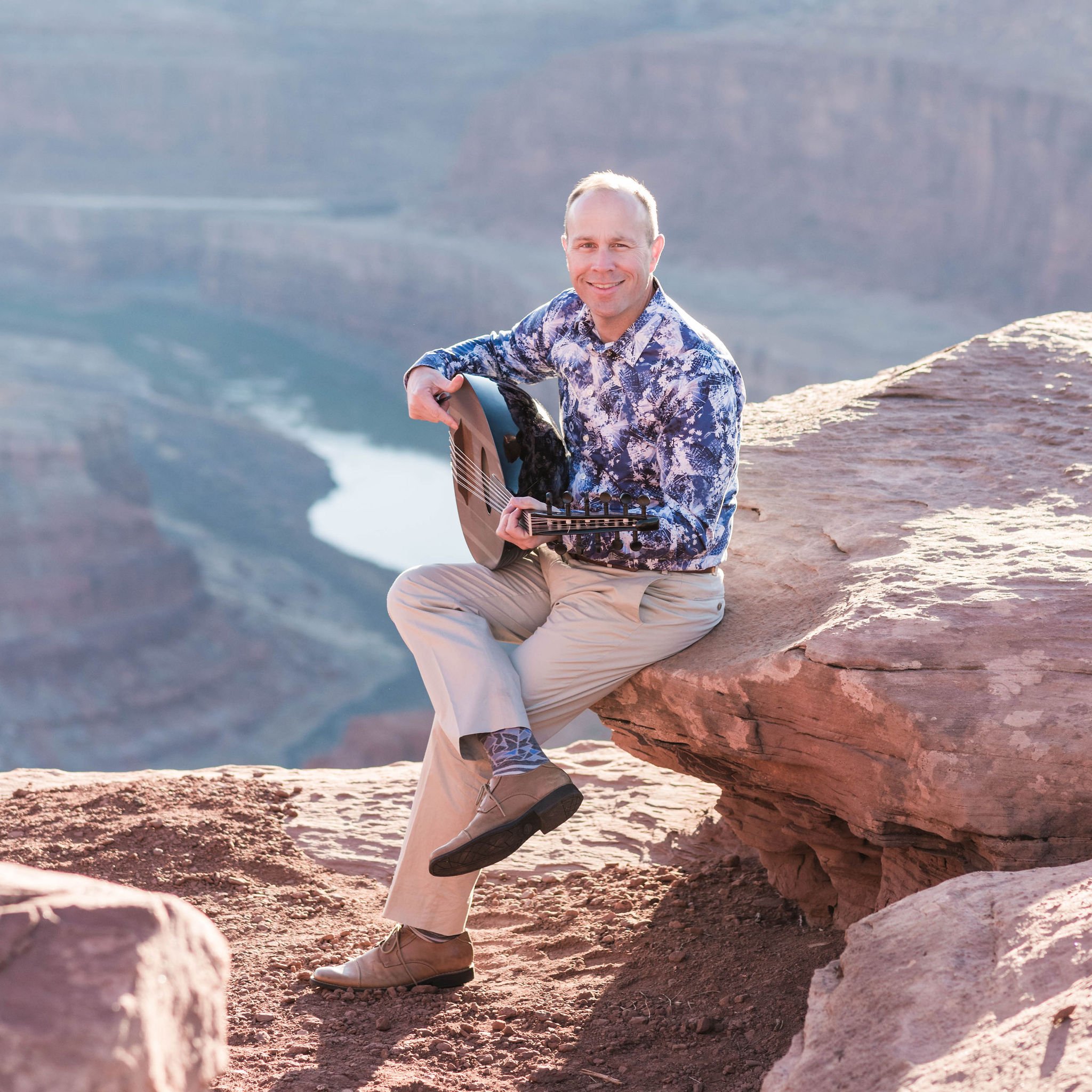
The descendent of Western frontier pioneer musicians, composer and oudist Ethan Wickman (b. 1973) grew up in a musical Southern California home where threads of melody knit together a sonic tapestry of hymns, folksongs, Beethoven and surf rock. Raised between the sublime vastness of the Pacific Ocean, and the immense northern expanse of the Sonoran Desert, the landscape beckoned the promise of possibility and the prospect of transcendence. Early training in piano, guitar, and voice led to university studies in composition (Brigham Young University, BM; Boston University, MM; University of Cincinnati-College Conservatory of Music, DMA), and then to studies of oud (Arabic and Turkish Lute) and musics of the Middle East and Türkiye with Ramy Adly, and Yurdal Tokcan in Istanbul.
With an expressive lyricism gleaned from his vocal studies, lush harmonies from Western polyphony, and the contemplative modal inflections of an oud improvisation, Wickman’s music invites listeners into his work as a space for reflection and catharsis. Woven together, these influences imbue his music with a searching spirituality and a yearning to communicate depth and compassion with immediacy and empathy. Two recent oratorios (To a Village Called Emmaus and That They Might Have Joy), draw on sacred texts to achieve this end. Another recent major work (Shimmers of Byzantium for chamber ensemble, voices, and organ) leans heavily into his training on the oud in a setting of W.B. Yeats’ epic mystical poem “Sailing to Byzantium.” His cantata Ballads of the Borderland juxtaposes family stories and mythologies within a texturally sweeping language that universalizes the experience of migration and assimilation.
Described as “a composer of facility and imagination, the kind to whom performers and audiences respond” (The New York Times), and for a music in which “the spiritual sublime is surprisingly close at hand” (WQXR-FM), Wickman’s compositions have been performed by soloists and ensembles in venues in the U.S. and around the world. He has received grants and commissions from the Barlow Endowment, Fulbright, Meet the Composer, the American Composers Forum, the Wisconsin Music Teachers Association, the Utah Arts Festival, the San Antonio Opera Guild, and Chicago's Music In The Loft. He was awarded the Jacob Druckman prize at the Aspen Music Festival, the Harvey Phillips Award from the International Tuba Euphonium Association, first place in the Utah Arts Festival Chamber Commission Competition, was a finalist for the ASCAP Rudolf Nissim Orchestral Composition Competition, and a semi-finalist for the American Prize.
Currently Professor of Music Composition and Theory at the University of Texas at San Antonio, he was formerly on the faculties of the University of Wisconsin-Eau Claire and Indiana University-South Bend. An advocate for the music of other living composers, he served as Executive Director of the Barlow Endowment for Music Composition at Brigham Young University from 2015-2020.

Double bassist, Jeremy McCoy, is retired Assistant Principal double bass of the Metropolitan Opera Orchestra and former faculty at the Manhattan School of Music, Bard College Conservatory of Music, Montclair State University, Columbia University, the Bowdoin International Music Festival and the National Youth Orchestra of Canada. He is a graduate of the Curtis Institute of Music and has appeared as recitalist and chamber musician at festivals across the United States, in Canada and Japan. As one of New York City’s most active commercial session players, Mr. McCoy performed on dozens of motion picture soundtracks and recorded with a diverse group of popular artists. His students hold positions with orchestras throughout North America, Europe, Australia and East Asia and have made careers in both college and public school music education. As a new resident of San Antonio, Mr. McCoy has had the pleasure of performing regularly with the San Antonio Philharmonic and with some of the city’s fine chamber musicians.