George Gershwin is one of the only composers who truly integrated jazz in all its style, harmony, and soul into larger-scale classical forms. Come share the experience of hearing this unique arrangement of his iconic 20th-century work Rhapsody in Blue for piano, strings, and clarinets, along with other Gershwin gems and complementary works, at the beautiful San Antonio Botanical Garden.
program
George Gershwin | Promendade
George Gershwin | Prelude no. 2 for Clarinet and Piano
George Gershwin (arr. Earl Wild) | Embraceble You
Maurice Ravel | String Quartet | Allegro moderato - très doux | Assez vif - très rythmé
George Gershwin | Lullaby for String Quartet
George Gershwin | Bess, You Is My Woman Now
George Gershwin | Rhapsody in Blue
program notes
George Gershwin is one of the only composers who truly integrated jazz, in all its style, harmony, and soul, into classical forms. Although his song-writing skills and instincts for jazz were quickly lauded, he was fascinated by classical music and the modern European composers of the time (Ravel, Debussy, Schoenberg, Berg, etc.). He even tried to take composition lessons with Nadia Boulanger and Maurice Ravel, who rejected him not for any lack of ability, but to encourage him to preserve his own style: “Why become a second-rate Ravel when you're already a first-rate Gershwin?” Ravel wrote to him. His desire to fit in to the classical world is evident in some of his composition titles. His three “Preludes” for piano were intended to be twenty-four, just like Bach’s. A “Rhapsody” was a loose-formed Romantic-era work championed by composers like Brahms and Liszt. He produced a concerto, a set of variations, and of course an opera (Porgy and Bess), all genres common to the classical world.
Promenade (“Walking the Dog”) shows Gershwin’s talent for film music. It is a short musical number written in 1937 for the film Shall We Dance, starring Fred Astaire and Ginger Rogers. Gershwin captures the glee and pep of the small pup, eagerly following its owner and getting distracted by various smells. While the original does also feature the clarinet as a solo instrument, this program’s version is arranged for a smaller ensemble.
His Prelude No. 2 is one of three, originally intended to be 24 (the same number as Bach’s from the Well-Tempered Clavier, as well as Chopin’s). The tone is that of a melancholy, bluesy lullaby, with the middle section springing to life briefly with a more optimistic, dancing spirit. Originally for solo piano, this version features the clarinet’s rich tone and singing quality, and reminds us why this woodwind was a staple of jazz ensembles in the early 20th century.
American pianist Earl Wild was a virtuoso of the 20th century, called by critic Harold Schonberg a “super-virtuoso in the Horowitz class.” He holds the honor of being the only pianist to play for six consecutive presidents at the White House, from Herbert Hoover to Lyndon B. Johnson. Wild’s individualistic interpretations and transcriptions of classical repertoire are superb, and his 7 Virtuoso Etudes Based on Gershwin Songs are a shining example of his virtuosic style. Gershwin’s Embraceable You was written in 1928 for an unpublished operetta, and then published in 1930 and included in that year’s Broadway musical Girl Crazy. Since then, it has become one of the most famous jazz standards.
In his late 20s, Maurice Ravel composed his String Quartet in F major while studying at the Paris Conservatoire under the great composer and pedagogue Gabriel Fauré. The quartet was his first major chamber work and remains one of the cornerstones of the repertoire. His experimental use of harmony and timbre imbue the work with a unique sound which, even without the work’s other captivating qualities, is gripping in itself. The piece is dedicated to Fauré, though ironically, Ravel’s teacher did not immediately approve of it—perhaps due to its audacious modernity. Claude Debussy, whose own string quartet a decade earlier had clearly influenced the composer, famously defended Ravel’s work, writing:
“In the name of the gods of music, and in my own name, do not touch a single note of your Quartet.”
The work straddles Impressionism and Classical clarity. Its luminous textures, modal inflections, and rhythmic asymmetry show Debussy’s influence, but Ravel’s style is more architecturally precise and emotionally restrained—a balance of sensual color and impeccable craftsmanship that would define his mature voice. The second movement is memorable for its near-constant use of pizzicato (plucking), which creates a percussive and orchestral effect. There are Spanish (guitar) and even Javanese (gamelan) inspirations here, and like Debussy, Ravel seems to have been influenced by some of the then-exotic cultures and music presented at the 1889 Paris Exposition.
Gershwin’s Lullaby for String Quartet, also composed in his 20s, was unpublished and unknown for years after his lifetime, getting its first performance by the Juilliard String Quartet in 1967 (30 years after Gershwin’s death). With this humble work, he’s starting to experiment with classical forms and textures while using his more popular idioms and voice, before the Broadway and jazz worlds fully define his musical identity. This is a special glimpse into Gershwin’s formative stage as a composer finding his voice.
Bess You is My Woman Now is a song from Gershwin’s opera Porgy and Bess. During this heartfelt duet, the two confirm their deep love for each other. Along with Summertime, this tune became a jazz standard for countless instrumentalists to play and arrange.
Rhapsody in Blue is a perfect example of Gershwin’s unique ability to meld the jazz and classical worlds: virtuosic piano cadenzas and clear theme structures are met with carefree jazz rhythms and goofy woodwind solos. Rhapsody in Blue is as fun as it is expressive, and as serious as it is silly. The famous clarinet solo that opens the piece sets the tone: Gershwin is embracing his roots. Dialogue between the piano and orchestra is often flirtatious and complementary, particularly in the arranged version on this program, which allows some of the string players and clarinet to take even more solos than in the original version. As one would expect from a Rhapsody, the music changes styles and characters quite often, at times singing long, lush melodies one might expect of a composer like Rachmaninoff, and elsewhere launching into vibrant Afro-Cuban rhythms that groove and accelerate. Nearly a full century after its creation in 1924, the work remains a favorite across concert halls (and United Airlines planes) around the world.
featuring
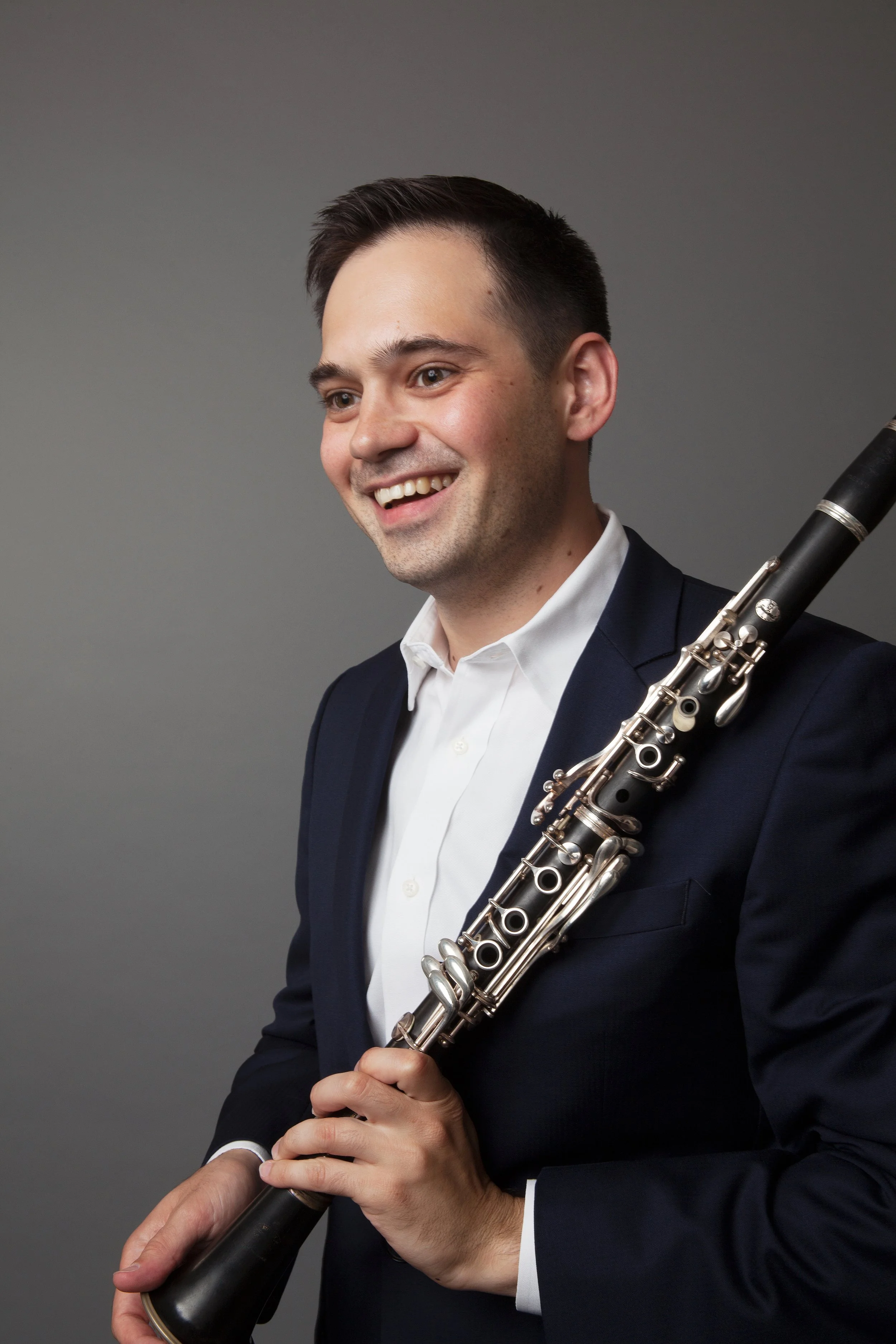
An "eloquent" clarinetist with "incredible artistry” Russian-born Stas Chernyshev has established a versatile career as an orchestral musician, soloist, chamber musician, and educator (Dallas Morning News, Theater Jones). Principal clarinetist of the Fort Worth Symphony Orchestra and Chautauqua Symphony Orchestra, Mr. Chernyshev has performed at such prestigious venues as Carnegie Hall in New York, Kimmel Center in Philadelphia, Kennedy Center in Washington, D.C., as well as in Switzerland, Spain, Germany, Russia, South Korea and Japan. A devoted chamber musician, Mr. Chernyshev has collaborated with Grammy-winning ensembles Eighth Blackbird and Orpheus Chamber Orchestra, commissioned new works for his instrument. He has been featured on WQXR -New York’s classical music station and WHYY’s television program - On Stage at Curtis. Mr. Chernyshev holds a Bachelor’s degree from the Curtis Institute of Music, and a Master’s degree from St. Petersburg Conservatory.
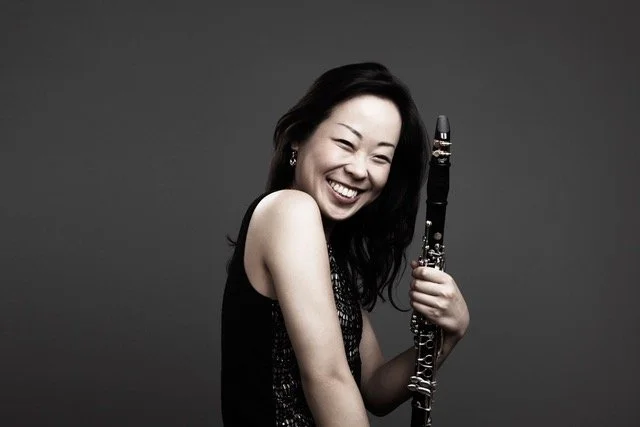
Ann Hung, originally from Taipei, Taiwan, began her musical journey at a young age, starting piano at five and clarinet at nine. Dr. Hung is an active performer in the Dallas–Fort Worth area, appearing regularly in both orchestral and chamber music settings. She has performed with the Fort Worth Symphony, the Cleveland Orchestra, members of the Orpheus Chamber Orchestra, and faculty from the Juilliard School.
In addition to maintaining a large private clarinet studio across the DFW metroplex, Dr. Hung is the Associate Director of Fort Worth Performances for Autism and co-founder of the Opus Nova Chamber Music Series. Founded to bring engaging and accessible chamber music experiences to the community, Opus Nova presents innovative programs in both traditional and nontraditional venues, connecting audiences with a wide range of repertoire and performers.

Brendan Shea is an internationally recognized soloist, chamber musician, and teacher. He began his studies at the age of 3 in Brussels, Belgium. He attended the Beijing Conservatory, studying with Zhao Wei, between the ages of 5 and 8. He made his debut with orchestra at the age of 11 in Washington D.C., playing the Paganini Concerto No. 1 in D Major with the Landon Symphonette. He also performed Sarasate’s Carmen Fantasy the same year in Carnegie Hall. He has since performed with orchestras in Brussels, Sendai, Indianapolis, South Bend, Seattle, and Boise. His award winning duo, The Shea-Kim Duo, tours internationally and performs recitals in Asia, Europe and North America. Their awards include the Ackerman Chamber Music Award and Gold Medal at the Manhattan International Music Competition. Their third CD, “All Roads”, was released by Blue Griffin Records in the fall of 2023, and has been reviewed favorably by Strings Magazine, Gramophone, The BBC, and others. Their previous CD, “The Sound and the Fury”, also released by Blue Griffin, was also favorably reviewed by numerous international publications. Their most recent studio album “Touch” was recorded in May of 2024, and will be released sometime in the summer of 2025.
Brendan is also an active chamber musician, performing and teaching at Encore Chamber Music Institute in Cleveland and Zephyr Chamber Music in Liguria, Italy. He has performed at festivals across the United States and Europe as an artist faculty, including the Anchorage Chamber Music Festival, Annapolis Chamber Music, Harborfront Chamber Music, Evergreen Chamber Music, and others. He premiered Frederic Rzewski’s Night, Death, and Devil with the Emmy Award winning 8th Blackbird. He has been a finalist and semi-finalist at the Queen Elisabeth, Isang-Yun, Seoul, Sibelius, and Carl Nielsen, and has taken first place with Honors at the Glazunov International Competition in Paris. His quartet chamber music awards were won when he played with the Wasmuth Quartet(Now Verona quartet) and include the Bronze Medal at the Osaka International Chamber Music Competition, Gold Medal and Audience Award at the Chesapeake International Chamber Music Competition, Silver at the Fischoff Chamber Music Competition, and Grand Prize at the Coleman Chamber Music Competition. He was also a violinist in the award winning Euclid Quartet and was in residence at Indiana University, South Bend, and visiting faculty at the University of Notre Dame. He also previously served as concertmaster of the Boise Philharmonic and Langroise Trio Artist-in-Residence at the College of Idaho.
Brendan Shea is currently Visiting Professor of Violin and Chamber Music at Central Washington University. He resides in Ellensburg, Washington. He currently performs on a violin made for him by Samuel Zygmuntowicz, and a bow made for him by Delphine Petitjean.
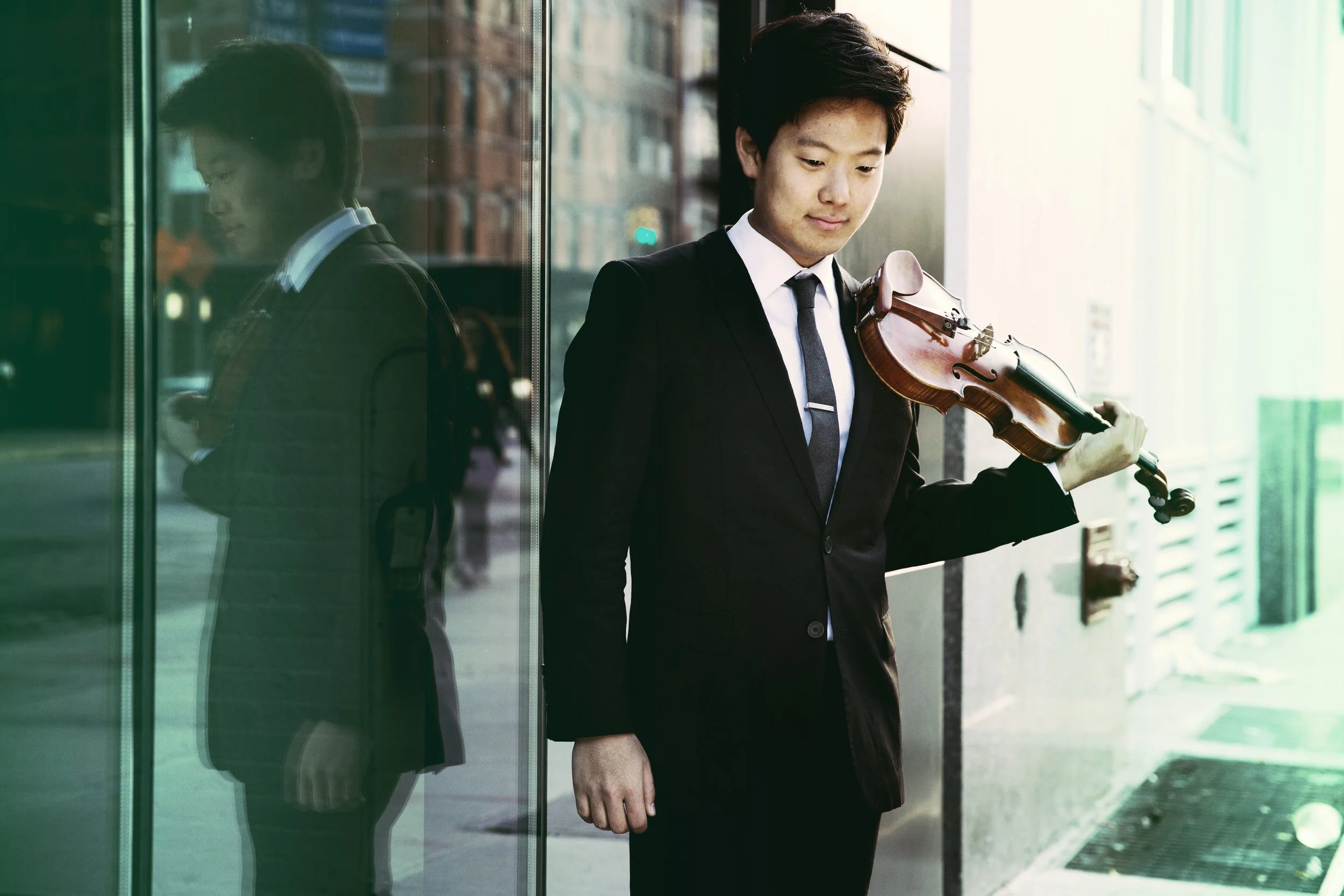
Siwoo Kim is an “incisive” and “compelling” violinist (The New York Times) who “plays with stylistic sensitivity and generous tonal nuance.” (The Chicago Tribune) Siwoo actively performs as soloist & chamber musician and he is the founding co-artistic director of VIVO Music Festival in his hometown of Columbus, Ohio.
Since his Carnegie Hall debut with the Juilliard Orchestra, he has gone on to perform as soloist with orchestras in four different continents. As chamber musician, he performs at festivals such as the Marlboro Music Festival, collaborating with revered artists including Mitsuko Uchida, Denes Varjon and Susan Graham. An advocate of new music, Siwoo premiered and recorded Samuel Adler’s only violin concerto on Linn Records and VIVO Music Festival annually co-commissions new chamber music works with Paris-based Ensemble Intercontemporain. This season, Siwoo recorded and released the premiere recording of Michael Torke’s “Last” on Ecstatic Records with the East Coast Chamber Orchestra (ECCO).
Siwoo received his undergraduate and graduate degrees from The Juilliard School where he studied with Robert Mann and Donald Weilerstein. He went on to complete a two-year fellowship at Carnegie Hall’s Ensemble Connect program.